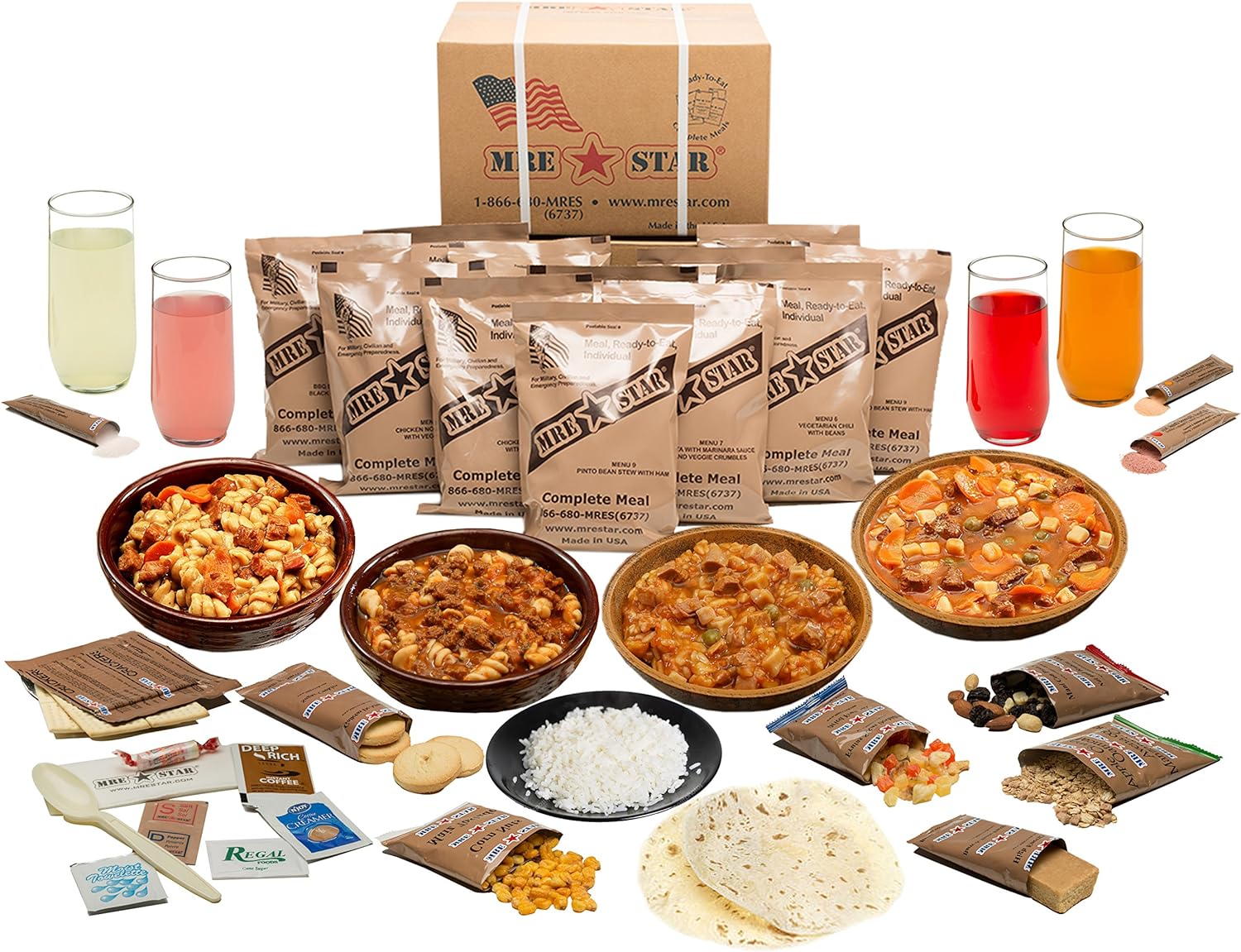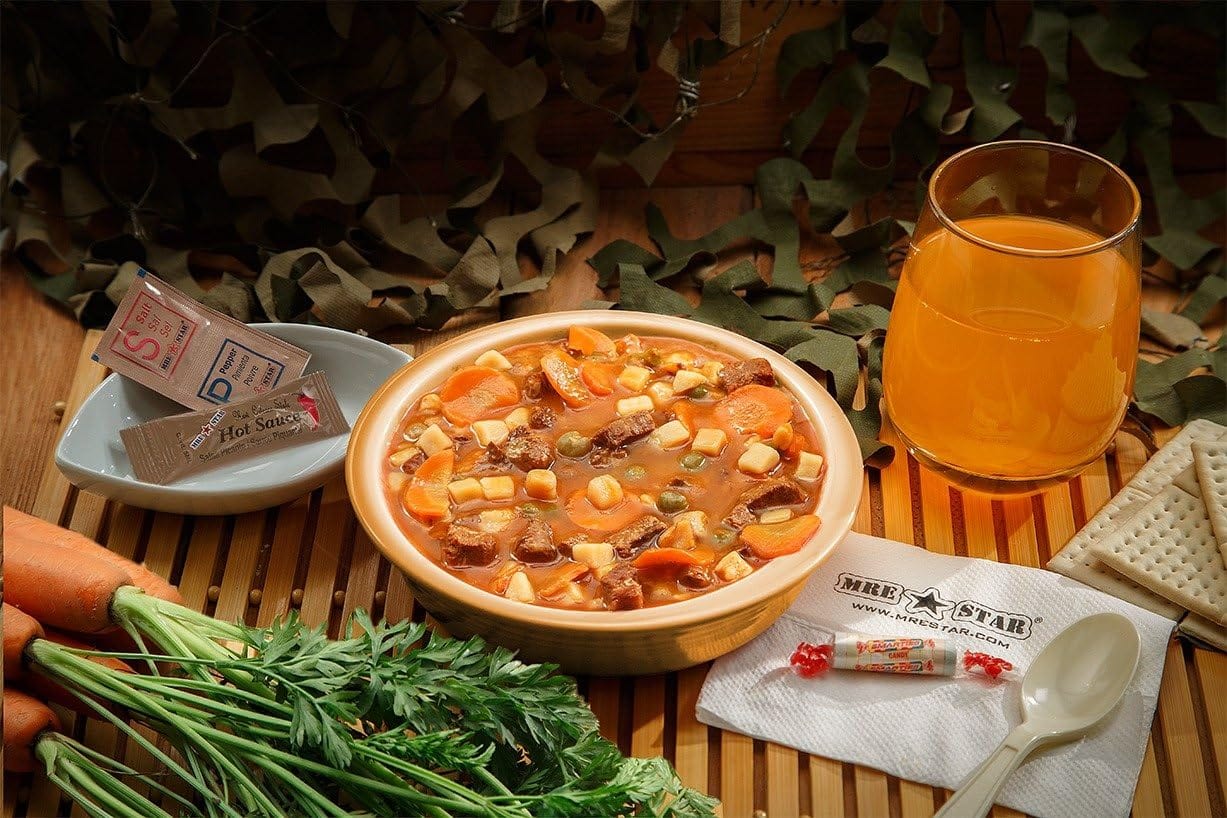
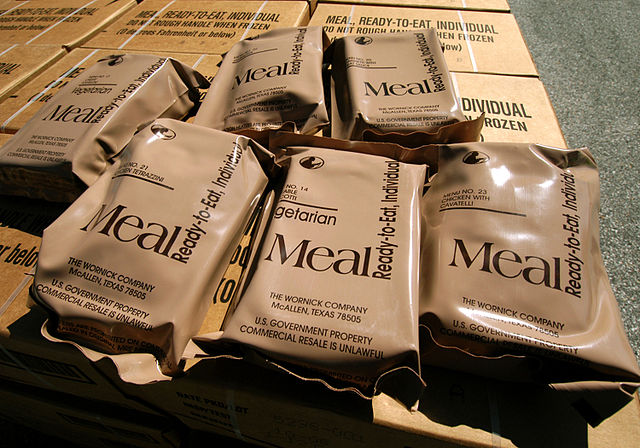
A standard U.S. military MRE contains about 1,250 calories on average. However, that number refers to the entire Meal, Ready-to-Eat—not just the main entrée. A complete MRE normally includes an entrée plus several other foods, such as crackers or tortillas, a spread, a snack or dessert, a beverage mix, and accessories.
Civilian MREs can have different calorie counts depending on the manufacturer and the contents. For example, a complete MRE STAR MRE averages approximately 1,200 calories per meal.
Quick answer: How many calories are in an MRE?
- U.S. military MRE: about 1,250 calories per complete meal on average
- MRE STAR complete MRE: about 1,200 calories per meal on average
- Individual entrée: only one component of the total calories—the complete meal includes additional foods
Exact calorie counts vary by menu, manufacturer, and meal configuration, so check the individual nutrition labels for precise numbers.
Below, we'll look at where those calories come from, what's actually inside an MRE, how civilian MREs compare with military rations, and how products such as MRE STAR fit into an emergency food supply.
How Many Calories Are in a Military MRE?
According to the U.S. Defense Logistics Agency, the contents of one military MRE meal bag provide an average of approximately 1,250 kilocalories.
The calorie distribution of the average military MRE is approximately:
- 51% carbohydrates
- 36% fat
- 13% protein
The Defense Logistics Agency also states that an MRE provides approximately one-third of the military dietary allowance for essential vitamins and minerals.
These numbers make more sense when you consider the purpose of the ration. Military MREs are designed to sustain people performing demanding activities when normal food-service facilities aren't available. They are therefore considerably more calorie-dense than many ordinary lunches.
Important: The commonly quoted figure of 1,250 calories refers to an average complete military MRE. It does not mean every MRE menu or every entrée contains exactly 1,250 calories.
MRE Entrée Calories vs. Complete MRE Calories
One of the most important distinctions when comparing MREs is the difference between an entrée and a complete meal.
The entrée is the main dish—for example, beef stew, chicken and rice, pasta, chili, or another prepared meal. But the entrée is only one component of a complete MRE.
A full MRE can add calories through:
- Crackers, tortillas, bread, or another starch
- Peanut butter, cheese spread, jelly, or another spread
- Snack foods
- Cookies or another dessert
- Fruit or dried fruit
- Candy
- Powdered beverage mixes
- Coffee, sugar, and creamer
As a result, comparing the calorie count of an entrée pouch with the advertised calories of a complete MRE can be misleading.
| Product Type | What It Means | Calories |
|---|---|---|
| Entrée | Main prepared dish only | Varies by menu |
| Complete U.S. military MRE | Entrée plus complementary meal components | About 1,250 average |
| Complete MRE STAR meal | Entrée plus starch, snack, dessert, beverage and accessories | About 1,200 average |
This distinction is also important when shopping. A case containing 12 entrée pouches is not equivalent to a case containing 12 complete MREs, even if both products are described using the term “MRE.”
What's in an MRE?
An MRE—short for Meal, Ready-to-Eat—is intended to be a self-contained meal rather than simply a packaged entrée.
The exact components vary, but a complete MRE commonly includes:
- Main entrée: the primary prepared dish
- Starch: crackers, bread, tortillas, or a similar item
- Spread: peanut butter, cheese spread, jelly, or another accompaniment
- Snack or side: nuts, dried fruit, snack mixes, or another item
- Dessert: cookies, cake, candy, or a similar food
- Beverage: powdered fruit drink, coffee, cocoa, or another beverage component
- Accessories: spoon, napkin, condiments, and other small items
- Flameless ration heater: included in many military MREs and some civilian MRE configurations
The particular combination depends on the menu and manufacturer.
MRE Nutrition: Protein, Carbohydrates and Fat
MREs aren't designed around calories alone. Military MREs are formulated to provide a combination of carbohydrates, fat, protein, vitamins, and minerals in a portable meal.
| Macronutrient | Average Share of Calories in a U.S. Military MRE | Primary Role |
|---|---|---|
| Carbohydrates | 51% | Primary source of readily available energy |
| Fat | 36% | Concentrated energy and dietary fat |
| Protein | 13% | Provides amino acids and contributes to energy intake |
Because individual menus contain different entrées and components, the nutrition label on a particular meal may differ from these overall averages.
Why Are MREs So High in Calories?
The approximately 1,250 calories in a military MRE can seem high compared with an ordinary meal. However, military MREs weren't designed around a typical sedentary lifestyle.
The Defense Logistics Agency describes the MRE as an operational ration intended to sustain an individual engaged in heavy activity, such as military training or operations, when normal food service isn't available.
High calorie density has another practical advantage: food carried into the field has to compete for space and weight with water, clothing, tools, and other equipment. A compact meal needs to deliver meaningful energy.
For civilian use, this means you shouldn't automatically assume that three complete MREs per person per day are appropriate for everyone. Individual calorie needs vary according to factors such as age, body size, activity level, environment, and dietary requirements.
If you're trying to determine how much food your household actually needs, see our How Much Emergency Food Should I Store? guide.
Are MREs High in Sodium?
MREs can contain a significant amount of sodium, although the exact amount varies by meal and manufacturer.
This is another reason to distinguish between the nutritional requirements of military field rations and the way a civilian typically eats at home.
For a current civilian example, MRE STAR's published specification for its complete M-018/M-018H meal lists an average of approximately 1,515 mg of sodium per meal.
If you monitor sodium intake, check the nutritional labels on the specific meal components rather than assuming that every MRE has the same sodium content.
Are MREs Healthy?
Whether an MRE is a good nutritional choice depends heavily on how and why it is being used.
An MRE has several nutritional advantages for its intended purpose. It provides substantial calories and a combination of carbohydrates, fat, protein, vitamins, and minerals in a compact meal that can be stored without refrigeration before opening.
At the same time, MREs can contain more calories and sodium than some people would choose for an ordinary meal, and individual menus differ in fiber, sugar, fat, ingredients, and allergens.
For civilian food storage, it is generally more useful to think of MREs as a specialized shelf-stable food option rather than as a replacement for a varied everyday diet.
MRE STAR Nutrition: A Real-World Civilian MRE Example
Civilian MREs don't necessarily follow exactly the same nutritional profile as U.S. military MREs. MRE STAR provides a useful example because its M-018 and M-018H products are sold as complete military-spec ready-to-eat meals.
According to MRE STAR's product specification, a complete meal averages approximately:
| Nutritional Value | MRE STAR Complete Meal |
|---|---|
| Calories | 1,200 average |
| Protein | 27 g |
| Carbohydrates | 170 g |
| Total Fat | 42 g |
| Sodium | 1,515 mg |
These figures are useful because they show that a civilian complete MRE can be nutritionally similar in scale to a military MRE without necessarily having exactly the same calorie or macronutrient profile.
What Comes in an MRE STAR Complete Meal?
A standard MRE STAR complete meal includes a main entrée plus additional components. Depending on the menu and current configuration, these can include:
- Main entrée
- Crackers, tortillas, or another starch
- Snack
- Dessert
- Fruit-flavored drink mix
- Coffee, sugar, and non-dairy creamer
- Condiments
- Spoon and napkins
The M-018H configuration also includes a flameless ration heater, while the M-018 configuration does not.
Both configurations contain 12 complete meals per case and average approximately 1,200 calories per meal.
Looking for Complete MREs?
Prepared Bee carries MRE STAR ready-to-eat meals, including complete meal configurations designed for convenient storage and use without conventional cooking.
Civilian vs. Military MREs: What's the Difference?
The basic concept is similar: both are designed to provide a durable, portable, ready-to-eat meal. However, civilian MREs and official U.S. military MREs should not automatically be treated as the same product.
Official military MREs are produced to meet U.S. government requirements and for military distribution. Civilian manufacturers sell products intended for the commercial market, and their specifications can differ.
| Feature | U.S. Military MRE | Civilian MRE |
|---|---|---|
| Primary market | Military and authorized government use | Commercial/civilian market |
| Average calories | About 1,250 | Varies by manufacturer |
| Components | Complete operational ration | Depends on manufacturer and product |
| Heater | Included in standard military MRE meal bags | May or may not be included |
| Retail availability | Not sold directly by DLA to private consumers | Available commercially |
For civilian buyers, the important question is not whether a commercial product looks exactly like a military MRE. Instead, compare what is actually included, calories per complete meal, manufacturer information, production date, storage guidance, and whether heaters are included.
Are MREs Dehydrated or Freeze-Dried?
No. MRE entrées are not the same as dehydrated or freeze-dried meals.
MRE entrées are fully cooked and contain their normal moisture. This means they can be eaten directly from the package without adding water to rehydrate the food.
| Food Type | Ready to Eat Without Rehydrating? | General Characteristic |
|---|---|---|
| MRE | Yes | Cooked and hydrated |
| Freeze-dried meal | Usually no | Most moisture removed |
| Dehydrated food | Usually no | Water removed for storage |
| Canned food | Yes | Cooked and hydrated in rigid packaging |
This gives MREs a major convenience advantage: you don't need to use your drinking water to rehydrate the entrée. The tradeoff is weight. Because the food still contains water, MREs generally weigh more than comparable freeze-dried foods.
How Do You Eat an MRE?
Despite the association with ration heaters, you do not have to heat an MRE before eating it.
The Defense Logistics Agency states that, except for beverages that require preparation, the meal is ready to eat. The entrée can be eaten cold when necessary.
If you prefer it warm, there are several options.
Using a Flameless Ration Heater
A flameless ration heater, or FRH, uses a chemical reaction activated by a small amount of water to generate heat. The sealed entrée pouch is placed alongside the heater so the meal can be warmed without a stove or open flame.
Follow the instructions supplied with the heater because designs and directions can vary.
Using Hot Water
A sealed entrée pouch can also be warmed in hot water according to the product's instructions.
Eating It at Room Temperature
Heating improves the experience of many entrées, but the food itself is already cooked. That makes MREs useful when conventional cooking isn't available.
Microwave warning: Do not put the unopened MRE retort pouch or flameless ration heater directly into a microwave. If the product instructions permit microwave heating, transfer the food to a microwave-safe container first.
How Long Do MREs Last?
Storage temperature has a major effect on MRE shelf life.
The Defense Logistics Agency states a shelf life of approximately three years at 80°F for the U.S. military MRE, with shelf life potentially extendable through colder storage before distribution.
MRE STAR likewise publishes temperature-dependent storage guidance for its products. Its specifications call for cool storage and show that higher temperatures shorten expected shelf life.
This means statements such as “MREs last five years” need context. Shelf life isn't determined by the calendar alone.
Factors to consider include:
- Storage temperature
- Temperature fluctuations
- Production date
- Condition of the outer packaging
- Condition of individual component packaging
- Manufacturer storage recommendations
A cool, dry, temperature-stable location is generally preferable to storing MREs for extended periods in a hot garage, attic, shed, or vehicle.
Can You Freeze MREs?
Intentional freezing is generally not necessary for storing MREs. MRE STAR specifically advises customers not to freeze its MRE products.
For household food storage, following the manufacturer's recommended storage temperature is preferable to intentionally freezing and thawing the meals.
What Are the Advantages of MREs?
MREs are useful because they combine several characteristics that are difficult to get from ordinary meals:
- Ready to eat: the entrée is already cooked.
- No refrigeration before opening: properly stored unopened meals are shelf-stable.
- Substantial calories: a complete meal can provide roughly 1,200–1,250 calories, depending on the product.
- Minimal preparation: no conventional kitchen is required.
- Individual packaging: meals can be distributed or carried separately.
- No rehydration of the entrée: unlike freeze-dried meals, the food already contains moisture.
These characteristics make MREs useful for emergency food supplies as well as for camping, hunting, fieldwork, road trips, and other situations where normal food preparation may be difficult.
What Are the Disadvantages of MREs?
MREs aren't the best answer for every situation.
- They are relatively heavy. The food contains water, unlike freeze-dried meals.
- They can be expensive per calorie. Basic pantry staples may provide calories at a lower cost.
- Some meals contain substantial sodium.
- Heat affects shelf life.
- Menus contain different allergens and ingredients.
- Not everyone needs 1,200+ calories at every meal.
For many households, MREs therefore make the most sense as one part of a broader emergency food plan rather than the only food being stored.
What Should You Look for When Buying MREs?
Before comparing MRE prices, make sure you're comparing equivalent products.
Check:
- Calories per complete meal
- Number of complete meals per case
- Whether the product contains full meals or entrées only
- Manufacturer
- Production or pack date
- Menu variety
- Nutrition information
- Allergen information
- Whether flameless ration heaters are included
- Storage recommendations
A cheaper case isn't necessarily better value if it contains fewer meal components or substantially fewer calories.
How Many MREs Should You Store?
There isn't a universal number of MREs that every household should keep.
Instead, consider:
- How many people you're planning for
- How many days you want your food supply to cover
- Approximate calorie requirements
- Age and activity level of household members
- Dietary restrictions and allergies
- How much other shelf-stable food you already have
- Available storage space
- Storage temperature
You also don't necessarily need to plan on three complete MREs per person every day. A household might use an MRE as one substantial meal while relying on cereal, canned food, shelf-stable snacks, dry foods, or other supplies for the remainder of the day's calories.
For a more detailed planning method, see How Much Emergency Food Should I Store?.
Frequently Asked Questions About MRE Calories and Nutrition
How many calories are in one MRE?
A U.S. military MRE contains approximately 1,250 calories. Civilian MREs vary. A complete MRE STAR meal, for example, averages approximately 1,200 calories.
Does every MRE have 1,250 calories?
No. The 1,250-calorie figure is an average for the complete U.S. military MRE. Individual menus differ, and civilian MRE manufacturers have their own specifications.
Is an MRE entrée 1,250 calories?
No. The entrée is only one component of a complete MRE. The approximately 1,250-calorie military figure includes the complete meal bag and its complementary food components.
How much protein is in an MRE?
The Defense Logistics Agency states that approximately 13% of the average military MRE's calories come from protein. The exact amount varies by menu. As a civilian example, MRE STAR lists approximately 27 grams of protein for its complete 1,200-calorie MRE.
How many carbs are in an MRE?
Approximately 51% of the average military MRE's calories come from carbohydrates. Exact grams vary by menu. MRE STAR's published complete-meal specification lists approximately 170 grams of carbohydrates.
Can you eat an MRE without heating it?
Yes. MRE entrées are already cooked and can be eaten without heating. Heating generally improves the eating experience but isn't required to cook the food.
Do MREs need water?
The entrée itself does not need water for rehydration. Some powdered beverages require water, and a small amount of water is used to activate a flameless ration heater.
Do MREs need refrigeration?
Unopened MREs are designed for shelf-stable storage and do not require refrigeration. However, storage temperature affects how long they remain within their expected shelf-life range.
Are MREs freeze-dried?
No. MRE entrées are fully cooked, hydrated foods. Freeze-dried foods have most of their moisture removed and generally require water before eating.
How long do MREs last?
The U.S. military MRE has a stated shelf life of approximately three years at 80°F. Shelf life is temperature dependent, so cooler conditions generally preserve quality longer while prolonged heat shortens expected storage life.
How many calories are in an MRE STAR meal?
MRE STAR specifies approximately 1,200 calories on average per complete MRE for its M-018 and M-018H products.
Understanding MRE Calories in Your Food-Storage Plan
The most important number to remember is simple: a complete U.S. military MRE averages about 1,250 calories. Civilian MREs vary, with complete MRE STAR meals averaging approximately 1,200 calories.
But calorie count alone doesn't tell you whether an MRE is a good value or the right product for your household. Look at whether you're getting a complete meal or only an entrée, the nutritional profile, menu variety, production date, storage requirements, allergens, and whether a heater is included.
MREs are especially useful when you want substantial calories in a self-contained meal that doesn't require refrigeration or conventional cooking. For longer-term planning, however, they can work alongside other shelf-stable foods rather than replacing everything else in your pantry.